
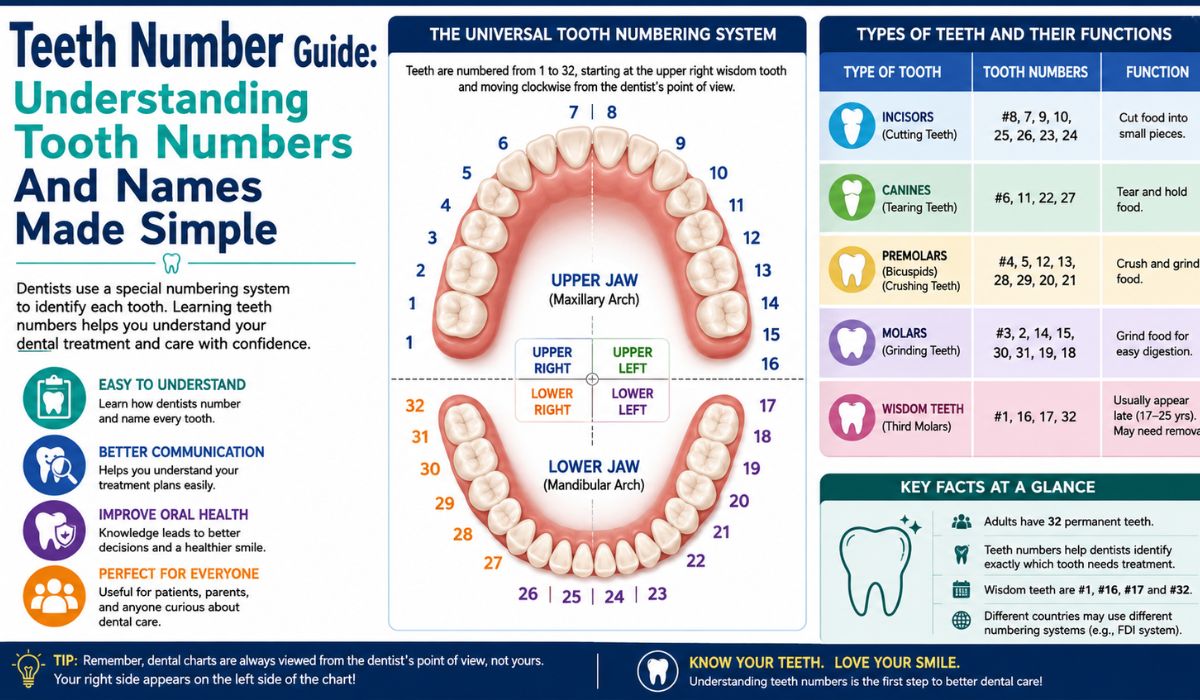
If you have ever looked at a dental treatment plan and wondered what terms like Tooth #14, Tooth #30, or Tooth #8 mean, you are not alone. Many patients are surprised to learn that dentists rarely refer to teeth by simple names during examinations and treatments. Instead, they use a standardized Teeth Number system that allows every tooth to be identified quickly and accurately.
Understanding Teeth Numbers can make a significant difference when discussing dental care. Whether you are getting a filling, crown, root canal, dental implant, veneers, or wisdom tooth extraction, knowing how the numbering system works helps you understand exactly which tooth your dentist is talking about. It can also help you read treatment plans with confidence and make informed decisions about your oral health.
In this guide, you will learn how the Teeth Number system works, how teeth are named, why dentists use dental charts, and how to identify every tooth in your mouth. You will also discover how baby teeth are numbered, how international numbering systems compare, and how understanding tooth numbers can improve communication with your dental team.
Quick Bio Information About Teeth Number
| Topic | Information |
|---|---|
| Primary Keyword | Teeth Number |
| Adult Teeth Count | 32 Permanent Teeth |
| Baby Teeth Count | 20 Primary Teeth |
| Most Common System In The United States | Universal Numbering System |
| Adult Tooth Numbers | 1–32 |
| Baby Tooth Labels | A–T |
| Upper Jaw Name | Maxillary Arch |
| Lower Jaw Name | Mandibular Arch |
| Numbering Starting Point | Upper Right Wisdom Tooth |
| Final Adult Tooth Number | Lower Right Wisdom Tooth (#32) |
| Number Of Mouth Quadrants | 4 |
| Front Teeth Name | Incisors |
| Pointed Teeth Name | Canines |
| Teeth Between Canines And Molars | Premolars Or Bicuspids |
| Largest Chewing Teeth | Molars |
| Wisdom Teeth Numbers | 1, 16, 17, 32 |
| Smile Zone Teeth | Generally #6–11 And #22–27 |
| International Alternative | FDI Numbering System |
| Orthodontic Alternative | Palmer Notation System |
| Main Purpose | Accurate Dental Identification |
What Is A Teeth Number System?
A Teeth Number system is a standardized method dentists use to identify and record individual teeth. Instead of writing lengthy descriptions such as “upper left second molar” or “lower right canine,” dentists can simply record a tooth number. This creates consistency across dental records, treatment plans, insurance claims, and patient charts.
Without a numbering system, communication between dental professionals would be much more complicated. A simple notation such as Tooth #19 instantly tells any dentist exactly which tooth requires attention. This standardized approach improves efficiency and reduces the risk of misunderstandings during treatment.
Today, several numbering systems are used worldwide. However, the Universal Numbering System remains the most common method used by dentists throughout the United States.
A Quick Overview Of Adult Teeth
Most adults have 32 permanent teeth, although some people may have fewer due to missing teeth, extractions, or wisdom teeth that never develop. These teeth are divided equally between the upper and lower jaws, with 16 teeth in each arch.
The mouth is further divided into four quadrants. The Upper Right Quadrant contains teeth numbered 1 through 8. The Upper Left Quadrant contains teeth 9 through 16. The Lower Left Quadrant contains teeth 17 through 24. Finally, the Lower Right Quadrant contains teeth 25 through 32.
This quadrant-based organization makes dental charts easier to understand and allows dentists to quickly identify the location of any tooth.
Understanding The Universal Teeth Numbering System
The Universal Teeth Numbering System begins at the patient’s upper right side. The upper right wisdom tooth is Tooth #1. Numbering continues across the upper jaw until reaching Tooth #16, the upper left wisdom tooth.
The sequence then drops down to the lower left side, where Tooth #17 is located. Numbering continues across the lower jaw until reaching Tooth #32, the lower right wisdom tooth.
One detail that often confuses patients is perspective. Dental charts are created from the dentist’s point of view while facing the patient. As a result, what appears on the right side of the chart corresponds to the patient’s right side.
Understanding this simple concept makes reading dental records much easier.
Complete Teeth Number Chart And Tooth Names
Each tooth has both a number and a descriptive name. The front teeth are known as incisors. The pointed teeth beside them are called canines. Behind the canines are premolars, often called bicuspids. At the back of the mouth are molars, including wisdom teeth.
For example, Tooth #8 is the upper right central incisor and Tooth #9 is the upper left central incisor. These two teeth are often the most visible when smiling. Tooth #6 and Tooth #11 are canines, sometimes called eye teeth because of their position beneath the eyes.
At the back of the mouth, Teeth #14 and #19 are first molars that play a major role in chewing. Wisdom teeth occupy the corners of the dental arch and are numbered 1, 16, 17, and 32.
Types Of Teeth And Their Functions
Each type of tooth has a unique shape and purpose. Incisors are designed with thin, sharp edges that cut food into manageable pieces. Humans typically have eight incisors, four on the upper jaw and four on the lower jaw.
Canines are the pointed teeth located beside the incisors. Their strong shape allows them to tear food efficiently. These teeth also contribute significantly to facial structure and bite alignment.
Premolars sit behind the canines and help crush and grind food. Adults usually have eight premolars. Further back are the molars, which have broad chewing surfaces designed for grinding food before swallowing.
Wisdom teeth are the third molars that generally emerge between ages 17 and 25. While some people experience no issues, others require extraction due to crowding, impaction, or alignment concerns.
Tooth Anatomy: More Than Just A Number
Every tooth consists of several important structures. The visible portion above the gumline is called the crown. Beneath the gums lies the root, which anchors the tooth securely within the jawbone.
The crown is protected by enamel, the hardest substance in the human body. Beneath the enamel lies dentin, a softer tissue that makes up much of the tooth’s structure. At the center is the pulp, which contains nerves and blood vessels that keep the tooth alive.
The root is covered by cementum and supported by the periodontal ligament, a specialized tissue that connects the tooth to the surrounding bone. Understanding these structures helps explain why different dental procedures target different parts of the tooth.
Teeth Numbers In Common Dental Treatments
Teeth Numbers appear regularly in treatment plans and dental records. For example, a dentist may recommend a crown for Tooth #30 after extensive decay. A root canal may be performed on Tooth #14 to save an infected tooth. An implant may replace a missing Tooth #19.
When reviewing treatment plans, understanding the numbering system allows patients to identify exactly which teeth require treatment. This knowledge often makes consultations less confusing and helps patients ask better questions about recommended procedures.
As digital dental records become more common in 2026, accurate tooth identification remains one of the foundations of modern dental care.
Front Teeth And Cosmetic Dentistry
Not all teeth receive equal attention in cosmetic dentistry. The teeth most visible during smiling and speaking are often called the smile zone. This area generally includes Teeth #6 through #11 in the upper jaw and Teeth #22 through #27 in the lower jaw.
Cosmetic procedures such as veneers, bonding, contouring, and whitening frequently focus on these teeth because even minor improvements can dramatically enhance a person’s smile. Since the front teeth play a major role in appearance, dentists carefully evaluate their shape, color, size, and alignment when planning cosmetic treatments.
Understanding Wisdom Teeth Numbers
Wisdom teeth are often the most discussed teeth in dental offices. They are officially known as third molars and are located at the very back corners of the mouth. Their Teeth Numbers are #1, #16, #17, and #32.
Many people experience complications when wisdom teeth emerge because modern human jaws are often too small to accommodate them comfortably. Impacted wisdom teeth may remain trapped beneath the gums or grow at unusual angles. This can lead to discomfort, infection, crowding, and damage to neighboring teeth.
Because of these risks, dentists frequently monitor wisdom teeth using X-rays and may recommend extraction when necessary.
Baby Teeth Numbering System
Children’s teeth use a different identification system. Instead of numbers, primary teeth are assigned letters from A through T. The lettering begins with the upper right second molar and moves around the mouth similarly to the adult numbering system.
Children typically develop 20 primary teeth. These teeth play an essential role in chewing, speaking, and guiding permanent teeth into their proper positions. Although baby teeth eventually fall out, dentists still track them carefully because their health affects long-term oral development.
Parents who understand primary tooth identification can better follow pediatric dental treatment plans and discuss concerns with dental professionals.
Other Dental Numbering Systems Around The World
While the Universal Numbering System dominates American dentistry, many countries use the FDI Two-Digit System. This internationally recognized method assigns each tooth a two-digit code that identifies both the quadrant and the specific tooth position.
Another popular system is Palmer Notation, commonly used in orthodontics and some regions of the United Kingdom. Palmer Notation combines numbers with quadrant symbols to identify individual teeth.
Understanding these alternative systems can be helpful when reviewing international dental records or receiving treatment abroad.
How To Read A Dental Chart
Reading a dental chart becomes much easier once you understand the numbering system. Start by identifying the tooth number. Then determine its location using the dental arch and quadrant. Finally, match the number with the tooth name.
For example, Tooth #8 refers to the upper right central incisor. Tooth #19 refers to the lower left first molar. By following this process, patients can quickly understand treatment recommendations and communicate more effectively with their dental team.
Many dental offices now provide digital charts that visually display tooth numbers, making it easier than ever to follow treatment plans.
Interesting Facts About Teeth Numbers
Teeth numbering may seem simple, but there are several fascinating facts behind it. The first molars are often among the strongest and most heavily used teeth in the mouth. Some people never develop one or more wisdom teeth, which is considered a normal genetic variation.
Dentists view tooth charts differently than patients because charts are organized from the patient’s perspective. This approach ensures consistency across all dental records.
Researchers also continue studying how genetics influences tooth development, eruption patterns, and even the presence or absence of certain teeth.
Conclusion
Understanding the Teeth Number system is one of the simplest ways to become more confident about your dental care. Whether you are reviewing a treatment plan, discussing procedures with your dentist, or learning more about oral health, knowing how teeth are identified removes much of the confusion surrounding dental terminology.
From Tooth #1 to Tooth #32, every tooth has a specific location, purpose, and name. By learning the Universal Numbering System, understanding tooth anatomy, and recognizing the different types of teeth, you gain valuable knowledge that can help you make informed decisions about your oral health for years to come. As dentistry continues to evolve in 2026 and beyond, understanding Teeth Numbers remains a practical skill every patient can benefit from.
FAQs About Teeth Number
What Is A Teeth Number?
A Teeth Number is a unique identifier assigned to a specific tooth within a dental numbering system. Dentists use these numbers to document treatments, diagnose conditions, and communicate clearly about individual teeth.
How Many Teeth Do Adults Have?
Most adults have 32 permanent teeth, including four wisdom teeth. However, some individuals naturally have fewer teeth due to genetics, extraction, or developmental differences.
Which Teeth Are Wisdom Teeth?
The wisdom teeth are Tooth #1, Tooth #16, Tooth #17, and Tooth #32. These are the third molars located at the back corners of the mouth.
Why Do Dentists Use Tooth Numbers?
Dentists use tooth numbers because they provide a quick, standardized way to identify specific teeth. This improves accuracy in records, treatment plans, and communication among dental professionals.
How Are Baby Teeth Numbered?
Baby teeth use letters A through T rather than numbers. This system helps distinguish primary teeth from permanent teeth in dental records.
What Teeth Are Most Visible When Smiling?
The teeth most visible when smiling are generally the upper front teeth, especially Teeth #6 through #11. These teeth are often the primary focus of cosmetic dental procedures.
What Is The Difference Between Universal And FDI Numbering?
The Universal System uses numbers 1 through 32 for adult teeth, while the FDI System uses two-digit codes that identify both the tooth’s quadrant and position.
Can Tooth Numbers Change?
No. Once assigned within a numbering system, tooth numbers remain fixed. Even if a tooth is removed, its number remains associated with that specific position in the mouth.
Recommended For You: 352 Area Code Florida: Location, Cities Covered, and Key Facts